
Showing posts with label tv news. Show all posts
Showing posts with label tv news. Show all posts
Monday, July 1, 2013
Feast Your Eyes...
The Huffington Post put this up and is calling it the "worst news graphic ever."
I beg to differ. This is, in fact, the best news graphic ever.
See, this is what you lose out on when you consolidate news graphic generation at a central hub: the joy of just letting the perpetually high, barely-out-of-college kids in the pre-pro animation department run wild.

Thursday, March 22, 2012
Censor-y Overload

I'll make this quick because, as you can probably tell by the lack of output here over the past couple of days, I'm still pretty busy at the moment.
Bravo to CNN.
No, really.
Earlier today, investigative correspondent Drew Griffin -- who's an old friend of mine, going back to our time together at KCBS here in Los Angeles in the 90s -- was having a conversation on-air about a horrific hate crimes case in Mississippi when he said the word "nigger," unbleeped. The case involves a guilty plea entered by three young white men who purposely beat up then ran down a black man in June of last year. Drew was talking about the sickening facts of the case and quoted one of the killers, 19-year-old Deryl Dedmon, as having thrown out a racial slur while admitting to the crime not long after the attack.
Drew's exact words: "Deryl Dedmond backs up and gets a good aim and just plows him over on the way out. To be absolutely factual, at the end of this, Deryl Dedmond is laughing with his friends and actually called on his cell phone and, pardon my language but there's no other way to say this, and said, 'I just ran over that f'ing nigger'"
While it's unfortunate that he even felt that he had to edit out the word "fucking," thereby also diminishing the awful heft of what came out of Dedmon's mouth on that night, it's good that he was willing to at least not cop out and "protect" the audience from a little bit of much-needed shock when it came to the epithet that was used. It should go without saying that Drew was reporting a story and had every right to deliver that story without resorting to childish -- yet inexplicably widely tolerated and even expected -- euphemisms.
Years ago, in response to the reporting on Michael Richards's now infamous rant, I said this about our PC-beholden culture's unwillingness to utter the word "nigger" in any context:
"Despite whatever heft, whatever power to destroy or dehumanize, that we've unwisely granted a single word -- any word -- in the end it is still just a word, and nothing more.
Except that in the most advanced and preeminent culture to ever exist upon this Earth, in the early days of the 21st century, it isn't just a word. On the contrary, the word 'nigger' holds an unparalleled level of ascendancy in our society. There's no better testament to the truth of this statement than the fact that otherwise educated, intelligent people -- the type who normally would rather step on a live land mine than be taken for an idiot -- will gladly allow themselves to be reduced to spouting the vernacular of a four-year-old to avoid speaking it.
No matter the alternative's power to offend and instigate, is there anything -- anything -- more painfully ridiculous than a grown man or woman saying, 'The N-word?' It's an absurd verbal tip-toe that not only proves that there is apparently no safe context in which the actual word can be uttered, but also that there exists an unspoken implication that those whom one would expect to be angered by the use of such a word are so stupid that they can't discern between the desire to dehumanize and subjugate and the need to openly discuss, and therefore should be protected from hearing the word altogether -- for the good of everyone. This latter possibility -- an indictment of an entire culture, whether out of condescension or outright fear -- is infinitely more offensive than the utterance of any one word."
So as much as this shouldn't be a big deal -- that a person reporting a news story on a guy who uttered a vicious racial slur actually says that slur and doesn't sugar-coat reality -- it is actually a very big deal.
By the way, this follows a debate over the Zimmerman 911 tape on Anderson Cooper 360 last night in which CNN actually did allow the word "fucking" -- said by Zimmerman -- to be aired uncut with the knowledge that bleeping it would prevent viewers from making up their own minds about what he said immediately after that word.
That's two for CNN.
Thursday, December 29, 2011
There's Always Room for One More

I was once fired by CNN for blogging. Just keep that in mind as you read this.
Gawker: Extorting David Letterman Not Enough To Keep Guy Out of a TV Job/12.29.11
The only way this story is surprising to you is if you've never worked in TV news and understand nothing about what a cesspool of drunken, drug-addicted, mentally unstable amorality it is. It's the Island of Fucked-Up Toys.
So, to recap: Joe Halderman, who went to prison for trying to blackmail one of the most famous people in television, has a TV job again (ID Discovery). Larry Mendte, who confessed to having an affair with his co-anchor then pleaded guilty to federal charges of rifling through her e-mail, has a TV job again (WPIX in New York City). Alycia Lane, that co-anchor, who was once arrested for allegedly slugging an NYPD cop, still has a TV job (KNBC in Los Angeles). Richard Quest, who was arrested in Central Park with a dildo in his shoe, rope tied around his balls and meth in his pocket, never lost his job and is still employed by CNN.
I blogged. And I guarantee you I'm still radioactive and will be for the foreseeable future.
God, I love that fucking insane business.
Monday, August 29, 2011
Quote of the Day, Jr.

"We're in the news business. We deal in doom."
-- WNBC anchor Chuck Scarborough, in a surprising moment of candor during the weekend's Hurricane Irene coverage in New York City
Matt Zoller Seitz's piece on the ridiculousness of some of the hurricane coverage is spot-on. This is my favorite quote from it because it sums it all up flawlessly:
"Newspapers and Internet-only news organizations are guilty of hype, too, but TV news is a different animal, and its excesses are of a different order of magnitude. TV news is not supposed to be processed in bits and pieces. It's designed to keep you mesmerized for hours with an endless series of voluptuously frightening images and worst-case scenarios. It's Cassandra in a box."
The question isn't whether the networks and locals were somehow irresponsible in the amount of coverage they gave to the impending arrival of Hurricane Irene and its strike along the coast; as predicted, the storm did very serious damage in some places and it's always best to hammer home to point that its potential dangers are not the kind of thing to simply be shrugged off. But the overall tone of the coverage, which is what Seitz is pillorying, was, as expected, deafeningly alarmist and over-the-top. Often needlessly so. And that brand of vaudevillian lunacy, in the long run, does more harm than good.
Thursday, August 25, 2011
Steve-D'oh

This is pretty damn hilarious.
Anyone who's read my little book, Dead Star Twilight, is familiar with the name Steve Hyvonen. He's a guy I used to work with years ago at the NBC owned and operated station in Miami and who I wound up being under again immediately after 9/11 -- that's because he was an executive producer of dayside news programming at MSNBC at the time. In the book, I describe him as a pretty harmless and likable goof -- certainly not a bad guy by any means but likewise no ferociously uncompromising journalistic iconoclast. Hyvonen always perfectly represented the kind of tediously average, whiter-than-white-bread influence that seems to assert itself more these days in local news than just about any other. He was never the type to make waves and he seemed content at all times to just do whatever that management guidebook he'd once read dictated and be back home to his suburban wife and 2.3 kids by supper; think Bill Lumbergh by way of Ned Beatty's Otis character from Superman. He certainly wasn't the kind of guy worth getting worked up over for any reason at all.
Which is why it's all kinds of amusing to find out -- and I missed this the first time around -- that last year Hyvonen made Keith Olbermann's "Worst Persons in the World" list at one point. That fact alone is worth pointing and laughing at; the fact that the inclusion was apparently made at the behest of a few people at MS who are still aware of Hyvonen's time at the network and have, shall we say, less than fond memories of him, is even more entertaining. What Hyvonen did to earn Olbermann's ire, by the way, tells you everything you need to know about his thinking. Once again, I have no problem at all with the guy -- but it's still a hoot.
Incidentally, the reason I stumbled across this has to do with my plans for Dead Star Twilight for the upcoming 10th anniversary of 9/11. A full announcement will be coming within the next few days.
Wednesday, August 24, 2011
Winds of Change

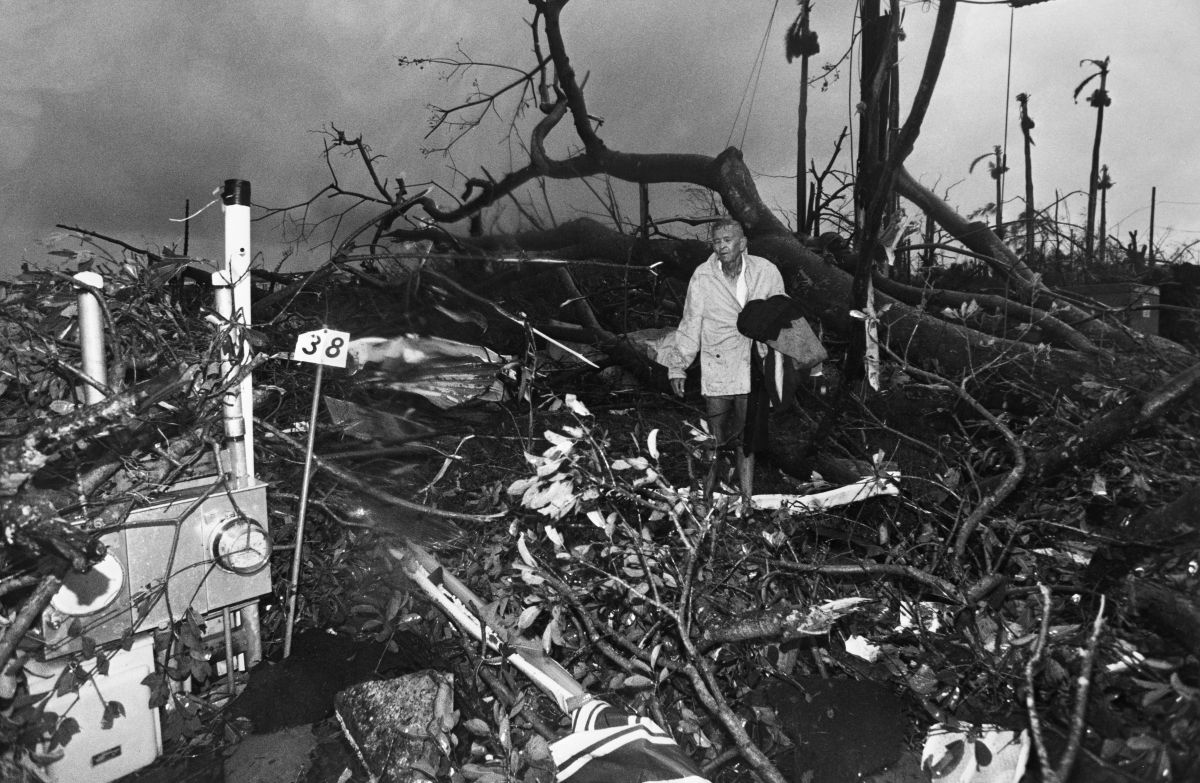
It's become something of a tradition around here each year: 19 years ago today, a good portion of my hometown of Miami was in ruins. That's because 19 years ago today Hurricane Andrew cut an almost incomprehensible path of destruction through South Florida. It killed 65 people and became the costliest natural disaster in U.S. history -- an ignominious title it held until Hurricane Katrina hit the Gulf Coast in 2005. It remains one of only a handful of Category 5 storms to make landfall in the Atlantic Basin. At the time, I was an associate producer at WSVN in Miami. I was 22 years old and had only been in television news for six months. Andrew was my first big story. What follows is a lengthy piece (feel free to scroll down for new material) but one that's generated an overwhelming amount of positive reaction from readers since it was first published in August of 2007. For those who've read my book, Dead Star Twilight, this also details my introduction to the girl who would eventually become an inescapable on-and-off presence in my life: Abby.
It's not the least bit surprising, by the way, that this year on the day I repost this a very large hurricane is preparing to skirt the Florida coast, apparently bound for the Mid-Atlantic states.
"Into the Maelstrom" (Originally Published, 8.24.07)
Part 1: The Gathering Storm
The first order of business was to find some appropriate music.
This sort of task is harder than you might think. I mean, really, what qualifies as a fitting soundtrack to impending catastrophe? It has to be menacing and ominous, yet atmospheric -- creating an almost Nouvelle Vagueish feeling of resigned serenity. It has to say, "In less than 24 hours, your entire hometown will be wiped off the face of the Earth by the wrath of God, and there isn't a damn thing you can do to stop it."
I settled on Ministry's So What and Scarecrow -- on repeat.
It was actually a rather fitting choice, given that I was still nursing a brutal hangover from the previous day's Lollapalooza festival -- the one which featured the spectacular lineup of Soundgarden, Pearl Jam, Red Hot Chili Peppers and, yes, Ministry. A full day's worth of drinking compounded by the sweltering and oppressive August heat should've been enough to lay me out flat for the next day or so, but what I'd found waiting for me on my answering machine when I got home at around midnight let me know in short order that I'd be afforded no such luxury.
My assistant news director had left seven messages -- all slight variations on the Where-the-Hell-Are-You theme.
When I picked up the phone and called him back, sitting down in an effort to steady the room, it sounded as if I had just been connected to the information kiosk in the center of Grand Central Station.
"What the fuck is going on there, Mike?"
"Jesus, Chez, haven't you turned on the TV lately?"
"No, I've been at Lollapalooza all day. I told you that's where I'd be when I left work on Friday." I pried myself up from the couch and shuffled across the hardwood floor of my living room, careful not to fall over face-first. "See, this is why I need a pager."
"You have to get in here now. Everybody has to come in," he said over the confusing din in the background. I could practically hear his face turning purple.
I hit the button on the TV and the picture coalesced into sharp focus just as the word "why?" came out of my mouth.
Before Mike could even answer -- "Forget it. I see why," I said, stunned into a near whisper.
I took a step back in an effort to truly grasp the magnitude of the image before me -- the one which seemed as if it had the potential to burst free of the two-dimensional confines of my television screen and begin drawing all fragile reality into its vortex.
It was a storm -- an infrared image, all furious reds and oranges, of a massive hurricane sitting directly off our coast. It looked like a buzzsaw, threatening to cut Florida in half. This was Andrew.
"I thought it was supposed to miss us," I said.
"It was," Mike said. "Not anymore."
"What the hell happened?" When I left work on Friday evening, the storm had barely reached hurricane strength again after being sheared into pieces by a blast of vertical winds.
"It turned earlier today, and gained strength. It's now a Cat-5," he said, then -- "It'll be directly on top of us in less than 36 hours."
There wasn't a force in the universe steady enough to keep my reality from shifting on its axis. Still, I instinctively started pacing the floor -- trying to knead the remaining fog out of the front of my head with my free hand.
"Alright, listen -- I need at least a few hours of sleep, Mike. I've been out drinking all day for God's sake. I'll be in as soon as I can."
"Okay, just make it ASAP please -- and whatever you need to pack up or secure at home, do it before you leave. Once you're here, you're not going back out to the beach until this thing's done with us."
Mike Dreaden was aware that I had moved into my own place on South Beach within the past month -- it was my first time living alone.
Great fucking timing.
"Yeah right, if there's a beach left," I said, then dropped the phone into the cradle and my weight back onto the couch with a dull thump, letting everything swirl into its own pinpoint vortex until all that was left was comforting black.
By the next morning, I had moved the few valuables I owned into a tight space at the top of the closet, packed an overnight bag, then took one last, sad look around the new apartment that I fully expected to never see again and headed off to work. I had little doubt that by the time I emerged from the nearly windowless, concrete enclosure of the WSVN studios the following day, South Florida -- whatever was left of it -- would be a very different place.
As I put the car in drive, the Ministry, for all of its portentous rage, was actually somewhat reassuring.
It was just a little after sunrise when I threw the 1988 Porsche 944 Turbo I had recently bought to reward myself for no longer working at Taco Bell into high gear, only to come around a corner and suddenly face a column of cars at a dead stop -- resting bumper to bumper along what seemed to be the entire length of the MacArthur Causeway leading off the beach to the mainland. I had already done my best to avoid allowing myself to be distracted by the unnerving sight of people running from their apartments along the surface streets of South Beach -- their arms loaded with belongings -- ready to jump into waiting cars that would take them somewhere. Anywhere but here. This sight however, the sight of so many people desperate to get out of the path of the oncoming storm, opened a painful pit in the bottom of my stomach.
I took a deep breath and whipped the car around, downshifting and slamming the gas pedal to the floor -- deciding not to actually leave the beach but instead to travel north along the ocean until I reached the bridge that would take me to North Bay Village, a quiet little island right across the bay from Miami proper and the home of WSVN. I sped along Collins Avenue -- weaving through traffic and silently thanking Al Jourgensen for being born.
One of the most surreal and ironically foreboding features of an oncoming hurricane is the near-perfect weather that it creates before it strikes. The pressure of the storm's powerful revolution seems to pull all surrounding clouds in toward its center, making for crystal blue skies in the hours leading up to its arrival -- the literal calm before the storm. With the exception of a very light breeze, you'd never suspect that a monster weather event, packing 160 mile-an-hour winds, was about to descend on you.
This is what it was like on the morning of August 23rd, 1992. It appeared to be the beginning of a hot, but otherwise gorgeous day.
It was only the palpable unease in the air and the oddly silent march to higher ground that betrayed the fact that something terrible was about to happen.
When I got to the station, I pulled my car into the most protected area of the parking lot I could find -- in the crux of the large, L-shaped three-story concrete building.
Once inside, I was quickly put to work pulling booth duty -- backing-up a rotating roster of producers, each of whom did a four hour control room shift directing our non-stop coverage. We had every crew possible in the field and the chopper in the air over the parking lot that the causeways and I-95 had turned into. I've come to believe that if you're not out doing live shots, the control room is the only place for a producer to be during rolling coverage. Anything else is a waste of his or her talents. I learned this that day at WSVN and would eventually put it into practice in every other shop at which I wound up working. My record is 14 straight hours in the control room, and during breaking news I wouldn't want it any other way.
On the day before Andrew came ashore, I willingly spent seven hours in the control room alongside the producers and directors, and in doing so earned the respect of my co-workers and managers. I had only been moved to the dayside shift -- the land of the living, as opposed to graveyard duty -- two months previously, and in a matter of a half-day, I was positioning myself to vault quickly up the ranks.
I had run to the bathroom and was on my way back to the booth when I heard someone call my name; I turned to see the familiar face of Chris Crane, the station's in-house music composer.
"I need a ride to my apartment," he said. "I gotta get my cat. Can you give me a lift?"
"I'm pulling booth duty, man."
"Yeah, I know. I talked to Dreaden, he'll take over for a few minutes."
I'd been to Chris's apartment before; he lived on one of the upper-floors of a gorgeous high-rise building right on the island -- not far from the station. I checked my watch; it was just after five. I hadn't been outside since my arrival early this morning and was curious to see for myself if conditions had noticeably deteriorated, plus I didn't want to be in any way responsible for the death of a cat, so I nodded and we headed for the door.
"Ministry -- fucking perfect," he said as I cranked the engine and the Porsche's speakers came to life.
It was there, in Chris's apartment high above the bay, that the true gravity of what was about to happen -- what was about to hit us -- became overwhelmingly clear.
As Chris called out for his cat, I walked slowly across the living room to the sliding glass doors that led to the balcony outside. Without thinking, seemingly hypnotized, I slid the door open and stepped out onto the balcony; I needed not only to see but to feel the ominous scene that was presented to us from this high up. The edge of the Earth was dark. It looked as if God himself had reached down and pummeled it with his fist -- making the horizon bruised and swollen. The wind had picked up, and as I closed my eyes and felt it wash over me, I realized that the only sound I could hear was the breeze itself.
I opened my eyes and looked down at the streets below.
There wasn't a car in sight.
The island was a ghost town.
And there, at the vanishing point, on a collision course with us, was a storm the likes of which almost no one in South Florida had ever seen.
I walked quickly back inside and slid the door closed. There in the darkened living room was Chris.
"You find your fucking cat?"
"Yup."
"Good, grab her and let's go. We need to get out of here -- now."
When I was nine-years-old, Hurricane David dealt a glancing blow to Miami. I remember my parents boarded up the entire house so that it was pitch black inside except for the few battery-powered lights we chose to keep running. I listened to the storm batter and beat the outside of our home for hours and hours; heard the boards nailed across the windows creak; listened to the storm try to get inside wherever it could. At the time, I drew comparisons in my child's mind to the scene in Close Encounters where the aliens surround Gillian Guiler's house in rural Indiana, submerging it in light and sound in an effort to get to little Barry. I imagined that Hurricane David was trying to do the same thing -- testing every possible entrance in an effort to take me and my family away.
This was at the forefront of my mind as Chris and I slammed the car doors shut and ran back inside the safety of the station just as the first of the heavy, low clouds began to pass over our heads.
As the glass doors of the lobby closed behind us, a steel shutter fell down behind it, locking into place.
Now, just like during David, I was inside a building which had ostensibly been sealed shut.
I got back into the newsroom just in time to overhear Mike Dreaden and the executive producers quietly lamenting over a recent and unfortunate turn of events. WSVN had just within the last couple of months fired its long-time meteorologist, Bob Soper, and had yet to find a replacement of his caliber. It basically meant that for the biggest storm in anyone's memory, our weather department was being manned by a bunch of relative novices -- pretty faces who were at the very least untested in the South Florida market, and therefore would probably be deemed untrustworthy by audiences when it really counted, like, oh say, now.
We needed meteorologists; we had Jillian Warry -- who would eventually go on to become Jillian Barberie, FOX's full-time, half-naked, mildly irritating weather vixen.
This was my first experience attempting to work my way around a truly stupid and short-sighted management decision.
It damn sure wouldn't be the last.
After getting a slice of pizza -- because the one thing that can always be said about a newsroom during a crisis is that at least there's free food -- I dodged the chaotic foot traffic in the newsroom and made my way over to the incoming feed area where Abby was sitting down, watching video come in from the trucks in the field. She was wearing her usual ensemble -- a t-shirt and a pair of jeans -- and her auburn hair was tied up in a pony-tail that bounced every time she barked orders through the microphone to our crews. She was as adorable at that moment as she had been a couple of weeks previously, when a few too many drinks at the bar across the street had led to a dangerous level of flirting and teasing between the two of us.
I liked Abby, and as far as I was concerned I could stand a friendly face.
"Don't you dare get near me unless you have an extra slice of pizza," she said without taking her focus away from the monitors in front of her.
"You want one? I can get you one."
"Fuck it." She turned to face me, seemingly annoyed at the distraction -- or maybe that she didn't have time to be distracted. "Just give me a bite of yours."
"Always." I smiled, holding the slice to her mouth.
"Don't start with me right now. In case you can't tell, some of us actually work around here as opposed to just kissing ass."
"I'm hoping to sleep my way to the middle. Busy later?"
She took a bite, dripping cheese on her chin which she quickly grabbed with her fingers and shoveled into her mouth.
"My God I love you," I deadpanned.
"Go away."
As the sun went down, the wind picked up and the approaching storm intensified -- the pressure dropping considerably. Andrew had become so tightly packed that it now resembled a giant tornado more than a hurricane. This was not going to be pretty, and deep down we were all scared beyond words. All day and afternoon, members of our staff had been running to and from their homes, trying desperately to secure what they could -- trying to get their families to safety. Many brought their husbands and wives -- their sons and daughters -- back to the station, as it seemed like the safest place possible given the circumstances.
In truth, this would have been the case were it not for one obvious consideration -- the one that was about to plunge what had already been a hectic and scary night into utterly terrifying confusion.
We were keeping one door open, and that was the back door that led from the newsroom out onto the helipad, and beyond that, the bay. After another hour or so in the control room, I once again felt like I needed to see what was happening for myself. Our crews were reporting intermittent bands of strong winds and light rain -- the outer rings of the storm -- so I ran downstairs from the booth and pushed open the unlocked back door. Outside I found some of our ENG guys gathering sandbags which they were preparing to put in place around what was obviously a weak spot in our defenses, namely the door I'd just come through. The wind was howling now, pushing a mist of salty bay water up over the seawall some fifty yards or so away from us.
Without taking my eyes away from the sight of the now black and roiling bay, I asked the obvious.
"Guys, what's the storm surge supposed to be with this thing?"
"12 to 18 feet," one of them answered.
I remember closing my eyes as I asked the even more obvious follow-up.
"And how high off the bay are we?"
"Not high enough."
As if timed for maximum dramatic effect, it was then that I noticed the red and blue lights casting long, deep shadows from the side of the building and heard the shouts from inside the newsroom.
The police had arrived.
They were forcing everyone out.
"This is a mandatory evacuation!" I heard, from a voice I didn't recognize.
The entire newsroom was in a state of pandemonium. Mike Dreaden and the other managers were trying to explain to the police that we had to continue broadcasting; the police weren't impressed, concerning themselves instead with only one unassailable truth: We were sitting on an island that was likely going to be completely underwater in a few hours. The dilemma for those of us who were currently holding the fort however was equally alarming: Andrew was now right offshore and we were being told to take to the streets and forage for sufficient shelter.
"Mike, what the hell are we doing?" I shouted over the insanity.
He looked around, as if willing himself to come up with a solution that didn't involve everyone being killed. "I have no idea," he huffed, then -- "We'll pack up the remaining trucks and go north to the transmitter. It's in Broward, we can broadcast from there. You guys can go with us -- or you can go inland and look for a safe place to spend the night."
Neither option was particularly appealing.
Out of the corner of my eye I saw Abby. As I might've expected, she looked like she was about to try punching one of the cops in the face, which admittedly would've at least landed her in a nice, safe jail cell on the mainland. I ran over to break up what was already turning into what the hippies used to call a "very bad scene."
"Abby, Abby -- knock it off." I put my hand on her shoulder and spun her toward me.
"Where are we supposed to go?" Up close, I realized that she looked less angry than she did genuinely in shock, like a frightened child.
"I don't know. Where do you live?"
"With my mother." I almost forgot that Abby had only turned 21 a few weeks ago. "Up on North Beach."
"Alright, that's not gonna work. We have to go inland. Come on."
And with that, I did something ridiculously impetuous -- or wonderfully noble -- or maybe I was just improvising. I grabbed Abby's purse, latched onto her hand, and we pushed our way through the crush of people moving toward the door and the police who were edging them out. When we got outside into light rain which was now being whipped along by heavy winds, we ran for the car.
I was fishtailing out onto the empty causeway in a matter of seconds, heading as far away from the water as I could get.
Aside from a police cruiser here and there, there wasn't a soul to be found anywhere on the roads. There were only the bands of wind and rain -- followed by the eerie lulls in between, when it felt as if all the oxygen had been sucked out of the atmosphere and replaced by the oppressive silence of absolute absence. The effect was simply chilling.
The Porsche screamed along US-1, the needle pushing 85.
I had no idea what our destination was, but I knew that I obviously had to stop at some point; the worst thing imaginable would be getting caught in the full brunt of the storm while sitting in a car. At one point, we passed the National Hurricane Center and I gave serious consideration to just pulling into the parking lot and banging on their door.
Hey guys, wanna REALLY help some folks out tonight?
But it wasn't long after we'd passed the NHC building that we came upon a small hotel, the lights of which were still inexplicably on. It was a two-story job with outdoor entrances to the rooms; not exactly the underground bunker I'd hoped for, but it would have to do. I pulled the emergency brake and swung the car around, then threw it into first and headed back toward what was at the very least a concrete structure.
I've been thankful for many things in my lifetime, but never have I been more thankful than when I realized that not only was the little guy at the Gables Inn sitting behind his desk and willing to open the door for us, but that at a few minutes past midnight on August 24th, 1992 -- the day Hurricane Andrew hit South Florida -- he had one room available.
There was chaos, absolute and infinite -- the terrifying sound of the world being torn apart. It was undeniably beautiful. Intensely sensuous. Abby and I listened to the fury of the wind and the scream of the roof being stripped away. We barely spoke, content to feel each other's husky, labored breathing. Exploding transformers right outside the window hammered the room with staccato blasts of blue and white light that sliced through the blackness and turned our shadows into living art against the wall. A final crack, and a sliver of the ceiling gave way, letting in warm drops of rain to mix with the sweat. Trees were ripped from the ground and slammed into the wall outside, their branches scraping violently against the pulsating window like fingernails across bare skin. It was nature in its simplest, rawest form -- monstrous and powerful and exquisite and pure.
I gently slid Abby down onto the floor between the bed and the wall and pulled the mattress up overtop of her, to keep her safe from any possible debris.
And then I walked hesitantly to the door, because like the child in Close Encounters, I had to see for myself what it looked like -- the monster scratching at the other side. The wind was blowing from the east, while the door to the room faced west; it was theoretically safe to open.
I placed my hand on the doorknob, twisted it gently and pushed.
What I saw when I looked into the storm was beyond description. My reaction, beyond awe. I've never seen such power.
I was in the center of the maelstrom.
I have no idea how long I stood there, but eventually I closed the door and crawled under the mattress with Abby, who was already asleep. I pulled her tightly against me, then closed my eyes and let everything go dark and silent.
Part 2: The Other Side
There was nothing, and that nothing was something -- its own imposing physical presence.
Although I was sure my eyes were open, there was no light; although I believed myself to be awake, there was no sound.
It wasn't until I felt Abby's soft hair in my face that I was sure we still existed at all. I exhaled and twisted my neck slightly, then reached a free arm up from around the young girl pressed against me and pushed hard on the mattress above us, sliding it out of the way. Suddenly, I could see -- the world going from black to shades of muted gray.
"Abby, wake up," I whispered.
She groaned and rolled over onto her back in the tiny shelter we had created between the bed's heavy box spring and the wall of the hotel room. My body ached as I pulled myself up and awkwardly half-crawled out into the space of the room. As reality began to come into a difficult focus, I heard the sound of dripping -- looked up and saw timid light coming through a hole in the ceiling -- water traversing its jagged edges and falling to the soaked carpet below.
I rubbed the haze out of my eyes. When I looked toward the window, I noticed that it was practically opaque -- covered almost completely by the branches of a tree that had fallen and now rested against it. Astonishingly, though, the window wasn't even cracked. How it held together I'll never know, but I'll always be grateful that it did.
I slid into my jeans then moved over to the door and pushed it open, bathing the room in soft, white light. I immediately noticed the strong breeze and heard it moving through tree branches that I couldn't see -- pushing leaves and debris along the ground. I stepped out onto the landing and allowed myself a first tentative look around. From my vantage point, facing west, perpendicular to US-1, there was little to see, unless you took into account the miracle of the Gables Inn's ability to have somehow just withstood a Category 5 hurricane without completely evaporating. I saw one or two people -- seemingly shell-shocked -- wandering the parking area directly beneath our second-floor room. I leaned forward and peered over the railing with a lump in my throat, fearing the absolute worst, only to find that aside from being plastered with wayward palm fronds, the Porsche seemed to have survived Andrew unscathed.
I jumped slightly when I felt something brush against me from behind, then closed my eyes and leaned back into the warmth of Abby, who at that moment felt even softer than I remembered. She'd wrapped herself in a blanket, and was now resting her head against my back.
"How bad is it?" I heard her voice, and felt her breath on my shoulder.
"I honestly don't know. We should get out of here and find out -- get to the station, if we can."
I turned around, held her tightly for a moment -- then kissed her gently and went back inside to get dressed and get my car keys.
It was bad.
It was very bad.
Abby and I drove in silence, slowly and carefully maneuvering the car around the heavy debris that littered the highway -- everything from street lights and powerlines to trees, billboards and even the massive air-conditioning units from the tops of the high buildings nearby; all were strewn across US-1 and had now turned it into a frightening obstacle course. Every so often, the oppressive stillness inside the car would be broken by the sound of Abby's quiet sobs.
Entire buildings were flattened. Once lush trees were made barren skeletons -- standing as sentinels over a wasteland, if they still stood at all. Everywhere, windows had been shattered, turning the structures they once adorned and protected into seemingly atrophied frameworks -- empty and bare. The roofs of homes had been shorn away wholesale and now rested in various spots along the highway so that it would've actually been possible to make a macabre game out of matching the house to its missing canopy.
There were no stop signs. No traffic signals. No electricity. No nothing.
And everywhere you turned your head, there were people trickling out from under shelter looking dazed -- concussed -- the way I always imagined a person looks immediately after being involved in a bad car accident. It's the face of someone who's gone into shock and is seconds away from collapsing -- someone who's already dead, he or she just doesn't know it yet.
We had been warned what a storm like this could do.
Our most dire predictions and worst fears weren't even close.
Abby and I were completely cut off from everyone. We couldn't reach our families, nor could we get in contact with our co-workers. The police had already set up blockades and detours aimed at keeping traffic flowing in certain areas -- safely out of others. With the radio now on and tuned to one of the few stations still broadcasting continuously, we decided to head north, toward Abby's family's condo; it was near water, but from what we were hearing, the storm had veered south at the last minute to come ashore in South Miami-Dade County. Places like Cutler Ridge, Homestead and Saga Bay had all taken direct hits and were now eerie dead zones; there was no information coming out of them. For all we knew at that moment, they simply didn't exist anymore.
The irony of course, which wasn't lost on either of us, was that by heading south on US-1 and ending up in Coral Gables the previous night, without meaning to, we had traveled into the storm as opposed to away from it.
"Next time, I'll let you drive," I said, upon learning of this little revelation.
The farther we got away from the southern end of the county, the more things seemed to return to normal. Power was still out almost everywhere, though, and when we finally arrived at Abby's mother's condo, we were forced to grab an emergency flashlight and navigate a dark and damp stairway -- with only the sound of dripping water echoing across concrete -- to get to the upper floors. We eventually made our way down a hallway illuminated by the sad glow of emergency lights, located the right door and dug Abby's keys out of her purse. Once inside, the gun-metal gray sky beyond the condo's floor-to-ceiling windows provided at least a workable amount of light.
Abby called out to her mother. I slipped into the darkened kitchen, found the faucet and splashed cool water on my face.
After a moment, Abby appeared as a silhouette in the doorway leading to the dining room.
"She's not here."
"She leave a note or anything?" I asked as I used the bottom of my t-shirt to dry my face.
"No, she probably went to my aunt's place up in Boca. That would've made the most sense. She'd figure I was okay."
"That'd be her first mistake," I said through a tired smile.
I heard a chuckle come from the silhouette.
"Wanna try using the phone, see if it works -- see who's out there?" I asked, after a moment of deafening silence.
Amazingly, the phone actually did work, the problem of course was that a lot of the ones we were dialing didn't. The station, as far as we could tell, was still out of commission, and Abby and I quietly admitted to each other the grim feeling of calling a television station in a major American city and getting a recording.
With no other legitimate options, and certainly nothing better to do, we turned on a battery-powered radio and laid down on the couch.
We fell asleep listening to stories of the end of the world.

Part 3: Among the Living
I came around the corner at a quick jog, only to be stopped in my tracks by a heavy black bag which hit me square in the chest. I fumbled for a second, caught it, then looked up to see where it came from. Standing in front of me was Mary Alvarez, our senior executive producer.
"Congratulations, you're going to South Dade. Be on the helipad in ten minutes."
She may as well have just spoken to me in Inuit.
"I'm going where?" I said, chasing after her as she turned and began taking long strides back to the newsdesk.
"Cutler Ridge. You'll be field producing for Sally," the back of her head said.
I suddenly debated telling her that, having never actually gone to journalism school, I had absolutely no idea what the hell a field producer did and therefore her choice of me for this particular assignment was a recipe for disaster. I thought the better of it in short order, choosing instead to bullshit around my complete ignorance.
"Uh, okay," I stammered. "Any particulars you're looking for while I'm down there?"
When in doubt, pretend to know things in the abstract while bolstering the ego of management by deferring to it and asserting that only someone of a higher pay grade can be brilliant enough to understand the specifics of anything.
"Find stories. Keep her in check. The first assignment should be a breeze -- God help you with the second."
"Look, Mary--" The cracks were quickly starting to show.
She spun around and looked me right in the eye.
"Nine minutes."
The morning after Abby and I made our exodus from the Gables Inn and our treacherous journey across Miami-Dade county, we were back at the station, which had just officially reopened for business. Right before dawn, we had left the condo -- where the power was still off -- and headed south along I-95, then east toward North Bay Village. We showed our WSVN IDs and had been allowed to pass a police barricade to get across the causeway to the island. Overall, North Bay Village wasn't badly damaged: a few traffic lights down, no power aside from backup generators, debris in the streets, but that was about it.
We hadn't been at work long -- dealing with the trauma of getting the station up and running again -- before Mike Dreaden noticed the two of us standing close together, whispering to each other, calm amid the madness. He lumbered over and asked where we'd each managed to find safety during the storm. Abby and I just laughed a little and separated without saying a word.
Now, the two of us were face to face again.
I had just come back from grabbing my overnight bag out of the car and had both that and the bag Mary threw at me earlier -- the one full of extra equipment for Sally -- slung over my shoulders. I looked like a pack mule.
"You know, I'm trying to stay professional about this whole thing," I said quietly, resisting the urge to run my fingers along Abby's arm.
"Yeah, I know. Do you have any idea how long you'll be gone?"
"None. A few days at least, I'm sure. Who the hell knows."
There was silence in the tiny space we occupied together at the center of the newsroom, contrasted by the roar of activity all around us. I checked my watch -- time to go. I glanced up at her and was just opening my mouth to say goodbye when she cut me off.
"Oh, fuck it," she said, and leaned in and pressed her mouth hard against mine. "Take care of yourself."
So much for discreet.
A couple of minutes later, I was ducking below the rotor of the chopper -- shielding my eyes against the whirlwind it kicked up. I threw both bags onto the seat in the back, then climbed in and slammed the door shut behind me. After patting the pilot on the shoulder and strapping in, I reached into my overnight bag and pulled out my CD Walkman, plugging the headphones into my ears.
As we lifted off, and the ground receded beneath us, Neil Young began to speak to me -- singing that our only hope was to keep on rockin' in the free world.
From the air, the scope of the destruction became clear. The amount of damage was staggering -- overwhelming.
As the chopper headed south, low along the coast, skeletal high-rises slid past us -- their windows blown out. Below us, houses were in pieces and trees blocked the streets and highways. Cars were overturned and scattered like children's toys.
When we reached the Dinner Key Marina in Coconut Grove, the images were almost beyond belief. Every boat, every yacht and sailboat along the docks, was smashed and sunk in the shallow water. Boats were piled on top of each other in a gruesome parody of dry dock -- splinters of what were once expensive vessels scattered everywhere. As we turned inland to bee-line toward our final destination deep within South Dade, I pulled down my sunglasses and leaned into the window -- awe-struck by what I was seeing.
There, on dry ground, laying against a line of trees at least a half-mile from the edge of the bay, was a ship. A freighter. It was hundreds of feet long. It had been picked up by the storm surge, blown inland -- and then left there when the waters receded.
As we pushed farther and farther into the heart of the dead zone created by the storm's fury, I realized that there was less and less to see -- simply because there was less and less there.
Everything was gone. Leveled. Wiped clean.
Entire communities, once thriving, had vanished as if they'd never existed. It was as if Andrew had a plan -- an actual thought process -- and it involved returning everything to zero. Years of evolution, both structural and cultural, had been obliterated. Thoroughly erased.
After what felt like an eternity, the chopper banked and began to descend. I looked down and once again felt a stab of dizziness penetrate the space directly behind my eyes. Our landing area was the Cutler Ridge Mall -- or where it had once stood anyway. Most of the mall -- formerly a giant enclosed shopping Mecca featuring stores like JC Penney and Sears -- had been flattened. What remained was nothing but rubble. Its parking lot was now a staging area for the National Guard; military green vehicles, hastily-constructed tents and troops at muster seemed to go on forever.
It cemented the impression that we were entering a war zone, which in fact we were.
The chopper set down in a barren area of the lot near what was once the north end of the mall. I ripped off my headphones, grabbed my bags and jumped out -- shouting a thank you to the pilot on my way. In front of me as I once again ducked beneath the rotor was a familiar face: One of our photographers -- a guy named Brad Friedkin.
"Welcome to hell," he shouted over the roar of the chopper.
"Is it all like this?" I returned at equal volume, still shielding my face.
"This? Oh God no. It's much worse." He was smiling from ear to ear. "At least they have power generators and air conditioners here."
He grabbed the black supply bag from my shoulder and led me to a waiting Chevy Blazer that was already running. As I climbed into the front seat beside him, the AC did indeed feel wonderful. The heat and humidity outside was punishing; I had only been out in it for a few minutes and I could already feel sweat running down the backs of my legs.
As Brad put the truck into gear, he glanced over at me.
"Do you have any idea what you're supposed to be doing here?"
Now that I was safely miles away from a manager: "Are you kidding? I was hoping you'd know."
He pushed hard on the gas and the truck twisted out onto a side street.
"Yeah, you're gonna fit in just fine," he said, seemingly as an afterthought.
Brad gunned the truck to the intersection of US-1, our only route down deeper into the scarred heart of the devastation and a straight line to the Cutler Ridge processing center. Unfortunately, the highway was a frozen line of cars; traffic wasn't going anywhere in either direction. Before I could even ask what his plan was or suggest one of my own, Brad had pulled alongside a national guardsman and rolled down his window.
"Excuse me," he shouted, getting the attention of the weary guardsman. "Is that thing loaded?" Brad was pointing to the M16 slung over the guardsman's shoulder -- a weapon which appeared to be missing a clip.
"Not right now," he responded.
"Good."
And with that, Brad swung the Blazer past the guy and sped off along the side of the highway, leaving a cloud of dirt in our wake -- by-passing the traffic completely.
The National Guard and the Office of Emergency Management had taken one of the few structures still standing in Cutler Ridge and turned it into a processing center for the victims of the storm. It was a place where anyone could come and find food and bottled water, both of which were almost impossible to come by otherwise as there was no electricity and no clean water for miles in any direction.
Day and night, the place was packed with crowds of desperate people -- all clamoring for items which they likely had taken for granted up until two days ago. South Dade had been plunged into the dark ages, and after only 48 hours without the modern conveniences that had over the years unwittingly become necessities, an almost feral atmosphere was beginning to take hold. Tempers were short. A primitive rage was practically visible behind the eyes of everyone you came into contact with.
It wasn't a reality anyone recognized anymore. It was a world consumed by madness.
For the first several hours after my arrival, I herded my anchor, Sally Fitz, here and there -- making sure she was in place for her live shots and keeping in constant contact with the station. Having been on the other side, in the control room, I was well aware of what the producers and directors needed from the crews in the field to keep things running smoothly and keep themselves from storming out the door and never coming back. Things went according to plan for the most part, despite the constantly evolving situation at the processing center and the fact that in a fit of bizarre anger, Sally had already told another of our photographers, Ralph Rayburn, to "shove it up his ass" live on the air. It was moments like those that forced me to retire to the air conditioned live truck every so often to sit quietly and contemplate a career change.
As the sun set, the darkness began to swallow the entire area whole. With no electricity for miles, a walk even a few feet outside the confines of the processing center would plunge you into impenetrable black. Once again, the world reset by the hand of God -- returned to a time before man and his innovations could lay any claims or plant any flags of progress.
But -- when you looked up, an entirely new reality was revealed. You could see forever. Past the stars. Past the galaxies. Maybe into the center of heaven itself. It was beautiful beyond dreams.
This was what I stared into that first night, before finally closing my eyes to get a couple hours of sleep. That infinite sky.
Somewhere in my dream, Abby told me that we have a problem -- and then told me again.
"We have a problem," came a different voice, one I didn't quite recognize.
I slowly pried open my eyes to find our truck operator towering over me. It was still dark outside.
I groaned, then -- "What's up?"
"The National Guard's threatening to kill Rick," he said matter-of-factly.
I just laid there for a moment.
Finally: "Well, is there anything we can do to stop them?"
"We should probably try."
"Yeah, I guess you're right."
I pulled myself up off the Astroturf carpet that I'd been laying on and rubbed the sleep out of my eyes with the fingers of one hand -- exhaled heavily -- then trudged off to find the National Guard commander in the hopes of keeping him from killing WSVN's main anchor.
Rick Sanchez was stationed about thirty miles or so south of us, at the second processing center -- the one in the even more heavily damaged city of Homestead. Already a somewhat divisive presence in Miami television, he was either busting his ass to get the word out about the desperate needs of those in the hurricane zone or arrogantly showboating -- taking "The Rick Show" on the road, as it were -- depending on your point of view. As it turned out, Sanchez would go on to inspire this same kind of extreme love or hatred throughout his career, even, eventually, on a national level; this crap was just the tip of the iceberg.
I finally found the commander in charge of the Guard detachment at our station.
"Sir, what's the problem?" I asked, still groggy.
He turned around and motioned to a column of semi tractor-trailers over his shoulder which he was, at that very moment, attempting to direct out of the traffic. "That's the problem," he said, frustrated. "Your man in Homestead went on the air and said they needed baby food. Guess what's in those trucks?"
Rick asks for it down there and it appears up here. Fucking lovely.
"Who sent all that?" I asked, pretending like I could somehow exert any control over the situation whatsoever.
"Who knows. One of the markets up in Broward probably. We're still trying to figure that out." He turned around and ordered a guardsman to put flares down in the road, then whipped his head back toward me. "This is the second time this has happened in 24 hours. We're gonna either pull him off the air or just shoot him -- unless you do something about this. We don't have any place to put all this crap and we don't have a way to get it all down to Homestead right now."
"So, it's basically just gonna go bad."
"Give the kid a prize," he said, stomping off.
About two minutes later, I was inside the live truck on the two-way with our newsdesk, trying to explain the situation in terms as unequivocal as possible.
"If we don't put a muzzle on Sanchez, they're gonna dispatch Martin Sheen up the river to take him out."
"Well, you know how it is with Rick," came the response from Dreaden.
They're helpless parents who can't control their problem child.
"Just do something please. They're gonna shut him down -- I'm serious."
As if on cue, there was a knock at the door of the live truck. I reached over and opened it and standing there was a guy in a sweat-soaked t-shirt and a trucker hat.
"Hey, you with the TV? We got a bunch of stuff your guy says they need down in Homestead. Where do you want it?"

It was later that day that I tied a bandana around my head to soak up the filthy sweat and set out with a photographer to find a trailer park that supposedly had been all but annihilated by Andrew. An hour or so previously, Sally Fitz had sought me out to tell me that she'd heard rumors of the tiny community and that it had yet to be photographed by any news crews. So, myself and a shooter named Eddie grabbed some equipment, climbed in the back of a pick-up that was driven by someone who said he knew of the trailer park in question and wanted everyone to understand what had happened there, and were soon on the road headed for God-knows-where.
As we rode under a sky that was nearly white with moisture, as well as the ugly gray clouds that punctuated it, we shot video of the homes and businesses that we passed. All were badly damaged, and yet many looked as if they'd been boarded up after the storm hit, in an effort to protect what could still be salvaged. Everywhere, there were signs on various properties which featured menacing warnings of the harm that would come to looters, should they even consider trying to take what little of value the hurricane had spared. Given that there was almost no law to speak of in South Dade at the time, I tended to believe, say, the sign that read: LOOTERS WILL BE KILLED!
The truck veered off the highway after some time, and pushed down a dirt road and through tall reeds. After several minutes of rough riding that nearly bounced the two of us out of the back on more than one occasion, we entered a clearing -- an open field surrounded by low, barren trees.
It took me a moment to realize that it wasn't a clearing at all. It had once been a trailer park.
There was nothing left of it now. Not a thing was intact. Nothing stood higher than maybe a couple of feet off the ground.
I climbed out of the truck as it stopped and took a few cautious steps forward. There was no sound at all; even the hot breeze seemed to be silent, as it swept not through dense leaves but around desolate and bare branches. I advanced slowly down what had been one of the wide streets between the homes. As I did, I looked to my left and right -- taking in the wreckage of what had once been people's lives.
There was a crib, crushed under the twisted metal of one trailer's roof. Pictures scattered everywhere. Memories. There were toys. A child's shoe. Clothes. Even a wedding dress. A bicycle with training wheels still on it was now perched in what little remained of a tree.
A thumping sound finally broke the crushing silence, the sound of helicopters. As it grew louder, I looked up to see a formation of military choppers glide directly over our heads.
A moment later, the artificial thunder created by the helicopters retreated over the horizon and it was quiet again.
Except for the strange buzz.
And that was what I noticed what had been there all along -- busying themselves above the piles of wreckage where homes once stood. Where people once lived.
Flies.
We were standing several feet apart now, but I turned to Eddie and spoke in a near whisper. Sadly. Desperately. Helplessly.
"They're all dead."
He didn't answer -- just stared, slowly taking in the entire scene.
I swallowed a lump in my throat, which I hoped would help me fight back the tears.
"Yeah, there's no way they all got out," he finally answered quietly -- reverently.
Eddie glanced over at the man who'd driven us to this place. This graveyard. They both simply nodded at each other, and Eddie put his camera on his shoulder and began shooting. I moved back to get out of his shot, then happened to turn my head and look down. On the ground next to me was a picture of a middle-aged couple. They were smiling.
Three days later -- after reporting the story of the trailer park and alerting the overworked authorities to its existence; after mornings, afternoons and nights of live shot after live shot after live shot; after almost no sleep -- I caught a ride back to the makeshift landing pad at the Cutler Ridge Mall. I watched the chopper land. Boarded it. Closed my eyes as it ascended out of the war zone. Opened them only occasionally on the trip back to notice as green returned to the world below; as blue water appeared on the horizon and in time slipped gently beneath us; as the island of North Bay Village materialized ahead -- the island that everyone thought would be covered in water. I'd eventually return home and find that my apartment had also survived the storm. It had come through just fine.
As the chopper touched down on the helipad, its rotors still screaming, I once again thanked the pilot and stepped out into the whirlwind, where I'd spent a lot of time recently.
As I looked up, standing safely outside of the maelstrom was Abby.
She gave me a warm smile, and held me tightly when I reached her. Together we turned and walked toward the rear door of the station.
She held it open for me, and welcomed me back to work.
Thursday, June 30, 2011
Quote of the Day, Jr.

"It would've been funnier if the camera was actually set up by pedophiles."
-- Commenter "MoMo316" at HFBoards in response to the news that Chris Hansen of NBC's To Catch a Predator had been busted cheating on his wife through the use of a hidden camera
Why don't you have a seat right over there, Chris. Would you like a giant, ice-cold plate of irony while you wait?
What say we bring back this classic from the archive, shall we?
"Idiot vs. Predator" (Originally Published, 3.1.07)
You'd be hard-pressed to find a more malignant hive of ineffectual, Pavlovian dolts than the programming department of any television network in America. It's the kind of place where words like "imagination" and "innovation" are never more than a mission statement away, but the adventurous spirit behind them -- not to mention the risk that such a spirit invariably requires -- is happily disregarded at a moment's notice in favor of a safe bet or proven formula.
The clearest possible example of this lies in all those instances in which a show was canceled after literally one or two episodes. The flip side of the coin is that when a show does unexpectedly become a hit right out of the box, it's all but assured that network executives will immediately begin A) oversaturating their prime-time lineup with the thing until it becomes the mass-media equivalent of the Ludovico treatment from A Clockwork Orange, and B) desperately clamoring to get their hands on as many shows as possible which follow the same basic format. The folly of the former tactic becomes clear when you realize that Who Wants to be a Millionaire, once a breakout hit, is no longer on the air; the folly of the latter, when you think back to how many shows at the beginning of last season bore a striking resemblance to Lost and have now also been permanently banished to TV's Phantom Zone.
But no single hour of television has proven, at one time or another, every unprincipled, anathematic trait inherent in modern network programming than, surprisingly, Dateline NBC. This is not to say that NBC's long-running TV news magazine hasn't been a showcase for some excellent journalism; it most certainly has. It's simply that the true reason for its very existence -- to say nothing of its prime-time ubiquity -- seems to have never actually been about journalistic excellence.
Back in the late-90s, during the final glory days of NBC's prime-time hegemony, it was almost impossible to turn on the TV and not be granted an audience with the chiseled visage and soothing baritone of Stone Phillips; the show was literally on four-nights-a-week at one point. While this kind of prevalence might have suggested an unwavering faith in the content of the show at the highest levels of NBC, the reality was nothing quite so noble.
It was mostly a matter of saving a few dollars.
For those who don't understand how the television business works (or in many cases used to work, before huge entertainment conglomerates solved all the networks' programming problems by simply buying them), just because a show is on NBC, ABC, CBS or FOX doesn't mean any of those networks actually owns that show. A network has to buy it, typically at a hefty price. A show like ER used to cost NBC a small fortune -- an expense which was offset by the fact that the show was insanely popular and therefore raked in a very big fortune in ad revenue. (Incidentally, I have no idea what NBC is paying for ER these days but whatever it is, it's too much; the show is painfully average -- and the network knows it. A good rule of thumb: you can tell that a former hit is on its last legs when the promos for it feel the need to constantly remind you that it's "as good as it's ever been." If you're an actor on a show that's described in this way, you know it's probably time to call your agent, put off buying that new Aston Martin Vanquish and work something out with your coke dealer.)
But NBC owns Dateline outright; it's technically a product of the network's news department (why I feel the need to qualify that statement will become evident in just a second). What that means is that above all, the show represents one monumentally important thing to the network -- arguably the most important thing: it's cheap programming. During that period in the late 90s, Dateline NBC was no ratings bonanza, but it wasn't costing much either; it was less expensive to pack the schedule with Stone Phillips than it would have been to pay a production company for a show that might not have broken even.
The "innovation" and "imagination" of the programming executives were willingly ceded to the desire to "please" the "stockholders" and consequently "keep" their "jobs."
But then, not long ago, something unexpected happened: a few more people started watching Dateline.
What led them into the tent damn sure wasn't any of that boring "excellent journalism" stuff; it was the attraction that's been guaranteed to lure curious crowds across America for generations: a good, old-fashioned freakshow.
So began the ascendency of Dateline's popular, profitable, panic-inducing and thoroughly pointless series, To Catch a Predator. By now you probably know the drill -- in fact, if you believe the hyperbolic promotion, you or someone you know has already been outed as a child-molesting degenerate on national television by the dashing and intrepid Chris Hansen and his Turtleneck of Justice. For the uninitiated, it works like this: Hansen and crew team-up with police and a group which cleverly calls itself "Perverted Justice" to nab internet predators in the act. They pose as teenagers on-line, luring unsuspecting men -- and they are always men -- to a predetermined location somewhere in Suburbia, USA. Driven by the diving rod in his pants and the promise of an opportunity to use it on some teenage or pre-teen boy or girl, each hapless deviant leaves the comfort of Mom's basement and descends upon a typically modest home -- borrowed from a volunteer -- which in reality has been transformed from Rockwellian to Orwellian with the addition of enough hidden cameras to keep Room 101 busy for months. Once inside the spider's lair, the pervert in question usually meets an actor whom he believes to be the object of his on-line affection, but before any deal can be sealed -- SURPRISE! Out pops Hansen with what can only be described as the ultimate cock-block.
It's occasionally entertaining -- and occasionally painful -- to watch the erstwhile Romeos squirm like pigs stuck in a chute. They sweat; they twitch; their eyes dart around the room futilely trying to locate that hole in time -- the one that might whisk them away and back to the moment just before they made the worst decision of their lives.
For his part, Hansen casts himself as the avatar for every parent living in fear of the lecherous wolf constantly banging away at the other side of his or her child's computer screen. He furrows his brow with concern and reminds the unlucky deviants what they were ostensibly expecting to find when they walked through the door. (Just once, I'd love for one of them to be quick-thinking enough to jump up and say, "Actually, I'm here for you Chris Hansen, because I'm from ABC's new show, To Catch a Hack Journalist!") After listening to the inevitable litany of outlandish excuses, Hansen then figuratively throws off the comfortable blazer and puts on the inquisitor's robes, really going for the throat: he opens his manila file folder and begins reading the filthy words of each fiend back to him. Needless to say, it's comedy gold.
This is all followed by the unfortunate sap being taken into police custody.
Thanks to the Hansen Traveling Circus, Dateline NBC -- a show that once populated prime-time for practical reasons more than anything else -- has become a minor breakout hit. The programming executives at NBC now have the best of all possible worlds: an inexpensive show that can bring in a few advertising dollars and be peddled as nothing less than a service to the community. Paddy Chayefsky can rest peacefully in the knowledge that every single thing he predicted about the future of network television back in 1976 has come to putrid fruition.
In spite of its moderate popularity though, To Catch a Predator has had its very vocal detractors, for some reasons which should be obvious -- and a few others that aren't.
It seems impossible to defend someone who traveled a hundred or more miles in the hope of being rewarded with sex from a fourteen-year-old, and I certainly don't mean to do that. Still, on-line sting operations have always made me slightly nervous simply because of the questionable tactics employed by police and the somewhat nebulous nature of the charges typically filed against the accused: "attempting to solicit sex from a minor."
Early in my career, I worked with a meteorologist named Bill Kamal. He and I were little more than acquaintances, but for the most part he seemed like a decent enough guy -- despite his affinity for wearing large hoop earrings and pirate shirts when not on-air. Kamal was obviously a great fit with Miami and continued to work there long after I'd left -- pretty much right up until October 24th, 2004; that's the day he was arrested for driving his Corvette all the way up to Ft. Pierce to meet a young boy he had met in an on-line chatroom called "Boyzformen". The boy had said his name was Billy, and had claimed to be fourteen-years-old. The boy also claimed to have already had sex with an older man. The boy, of course, wasn't a boy at all; he was a St. Lucie County detective -- and he arrested Kamal on the spot. Inside Kamal's car, police found condoms and a water gun.
Like the guys on Dateline, Kamal rattled off a list of ridiculous excuses as to why he had toys in his car, not to mention child-porn on his computer at home. Eventually though, he was convicted in court and is now sitting in a federal prison, no doubt dazzling his fellow convicts with his impressive knowledge of cloud formations and the resilience of his sphincter.
Now make no mistake, Bill Kamal didn't drive 160 miles to chat about baseball and that new Green Day album -- not with the price of gas these days; Kamal was there to have sex with a teenager. The problem of course is that he didn't. In fact, not only did he not have sex with a fourteen-year-old-boy, there never was a fourteen-year-old-boy. He was always chatting with a grown man, regardless of what he may have thought. And that may be the problem: charging someone with soliciting sex from a minor when there wasn't a minor anywhere in the picture to begin with seems slightly underhanded; it relies fully on what Kamal thought was happening and what he intended to do about it.
I realize that this argument can essentially be applied to any kind of police sting operation, but such is the fine line between intention and execution.
Why couldn't Bill Kamal have simply said, "I knew it was a grown man all along -- that's just my fantasy?" In Kamal's case, the reason was probably because he had a trunk full of toys and a glove-compartment full of condoms (although even that could ostensibly be explained -- which Kamal of course attempted to do). Still, there's no law against possession of a concealed water gun. Once again, it relies on an intransigent knowledge of what was going to happen. At this stage of human evolution, Philip K. Dick's "Pre-cogs" are still only the stuff of imagination.
Chris Hansen and the investigators involved with To Catch a Predator have of course found a way to get around the "Hypothetical Victim" quandary; that's where the actors-pretending-to-be-teenagers come in. At the very least, it can be argued that they provide the dirtbags with one last chance to do the smart thing and back out. Yet again though, what's to stop someone from saying, "I figured it might be you Chris, but I came anyway because I wanted to be on TV. I'm sort of insane and act irrationally a lot of the time -- did you know I can also make myself invisible?"
This debate is entirely academic, particularly when Hansen and company actually have at times put more kids in harm's way than they've probably protected.
Just ask the town of Murphy, Texas.
NBC is still receiving letters and e-mails, not only from angry residents but from even angrier city councilmen. Their outrage stems from an "occupational hazard" involved in the production of To Catch a Predator -- one that's easy to overlook yet becomes glaringly obvious and gravely serious once recognized:
The show is drawing potential child-molesters into quiet neighborhoods.
You're probably aware of the phrase "Not In My Backyard" -- well, neighbors in Murphy, Texas weren't pleased when Dateline decided to lure alleged rapists to their backyard. They were even less pleased when police were forced to chase some of these guys through their backyard; when bags of drugs were found in their backyard; when the push to make exciting television was putting their backyard in danger.
A letter to NBC from a Murphy city councilman says it all:
"It was (the residents') streets, not yours, not Dateline's... You held a sting at a house within sight of an elementary school. An elementary school that had an early release on the day of your sting. A house right in front of a bus stop for our school children."
The councilman goes on to figuratively grab NBC executives by the throat -- stating a rather interesting fact which challenges the supposedly benevolent and judicatory intentions of To Catch a Predator: not one case for sexual solicitation was filed as a result of the sting in Murphy, Texas. While this denouement does admittedly come as a bit of a shock, the goal of the entire effort should never have been in question and should surprise no one. It was never about justice; it was always about money.
The formula for deducing any objective has always been simple: consider the source.
80% of NBC/Universal is owned by GE; the other 20% belongs to Vivendi. Both are publicly traded companies, which means that nothing at NBC is done without the stockholders in mind. When money is the goal, truth becomes nothing more than another commodity. Occasionally it's an advantage; occasionally it's an impediment.
Bottom line though: if you're looking for altruism, you're barking up the wrong peacock.
Of course, none of this has stopped NBC from pretending that the aim of To Catch a Predator is to actually catch predators -- and in some ways, that's the most egregious disgrace of all. Although a debatable amount of Schadenfreude is ripe for the picking every time a Hansen Home opens for business, that's not the kind of thing NBC can promote -- remember, Dateline is, nominally, a news show. Instead, the network uses the most sure-fire and time-honored tool in any modern news department's promotional vault -- the one that brings 'em in every time: fear.
Put simply, To Catch a Predator preys on your fears.
It preys on your belief that the violation and infestation of your home and family is never more than a mouse click away.
And guess who put that belief there in the first place?
Predator, and shows like it, likely couldn't exist were it not for the months and years of promotional carpet-bombing that came before them. Nothing gets the attention of the masses like a potential threat, and those whose job it is to sell you the news -- an item which ironically didn't need to be sold in years past -- know that full well. This is why there aren't simply meth users -- there's a full-blown meth "epidemic." This is why it is imperative that you and your family tune in tonight to get the latest important information on the Bird Flu. This is why each time there's a tragedy somewhere else in the country, your breathless local news anchor will -- without a doubt -- ask, "Could it happen here?" This is why you're probably scared to walk out your front door. But that's no use; the vermin have now found a way through your defenses and they're coming for the thing you hold most dear: your children.
Thank God, Chris Hansen is there to stop them!
If money is the goal, and truth is a commodity, then fear is the ultimate weapon.
This is not to say that there aren't dangerous people trolling the internet, looking to have sex with kids; there are. But never in the history of malfeasance -- in the history of anti-social behavior -- has there been an infringement that's easier to prevent. Contrary to what many opportunistic fear-mongers would have you believe, the boogeyman isn't actually living inside your child's MacBook; he's more than likely two time-zones away sitting in a dank one-bedroom apartment wondering why his mail-order bride is divorcing him and taking his kids -- or possibly why his new NAMBLA card hasn't arrived yet. That doesn't exactly rise to the level of clear and present danger. All you have to do to get rid of him is turn off your damn computer. All you have to do to ensure that his screen name never sullies any monitor in your home to begin with is talk to your children. If your twelve-year-old is spending a lot of time in chat rooms called "Boyzformen," it's safe to say that he's asking for far more trouble than the pathetic jerk on the other end of the line; that guy's just buying into what's advertised. Is he potentially dangerous to the world outside the Matrix as well? Possibly -- but once again, when it comes to keeping them safe, educating your children is far more than half the battle.
For God's sake, don't leave it up to Chris Hansen, NBC or the network programming executives.
They're just in it for the money.
Sunday, May 22, 2011
DXM History Repeats: Television

Our look back at some of the best television-related DXM pieces of the last five years continues with one of my personal favorites. It relates the details of an assignment that I and a CNN crew undertook to interview a death row inmate just outside Houston. This is what I call a "Special Edition" of the original piece, in that I added a couple of bonus features: playable audio of the music mentioned within the column and the truly shocking final twist to the story. The original piece has also been adjusted slightly, as I'm now in a position to disclose the name of the CNN anchor who worked with me on the story. In the original version, that anchor remained nameless.
The DXM Fifth Birthday Jubilee
Topic: Television
Number of Posts: 317
"Things To Do in Texas When You're Dead" (Originally Published, 8.25.06)
By the time you read this, Justin Fuller will be dead.
Wednesday, 8:43am
There's a specific mathematical equation which can be used to help understand why Houston is arguably the most God-awful place on Earth. It all comes down to the numbers: the fifth-worst traffic in the country, plus the second-worst air-quality, minus the constant 72-degree temperature which makes Los Angeles livable despite such problems, multiplied by the number of Texans equals, well, Hell.
A few minutes ago I purposely ignored the flight attendant's request that I switch off all portable electronic devices, choosing instead to continue listening to Black Rebel Motorcycle Club's Howl album blasted at full-volume through my iPod. Anything to make descending through a layer of shit-brown haze slightly less depressing.
I'm now standing in baggage claim with my photographer. We've unloaded six pieces of luggage filled with heavy camera equipment and are currently engaged in a harried conversation with an employee of Continental Airlines. This employee's sole reason for existence over the next few hours will be to find a seventh piece of luggage which has apparently vanished into thin air somewhere between Laguardia and George Bush Intercontinental Airport.
That's my first impression of Houston this morning: lost luggage, an airport named after the man whose sperm mutated into George W. Bush, and a sign I'm leaning against which bears a likeness of the Houston Police Department seal. It reads, "Order Through Law. Justice With Mercy."
How reassuring.
I can't leave this place quickly enough.
Wednesday, 9:52am
Fortunately, the wayward bag didn't contain any vital piece of camera equipment; unfortunately it did contain a vital pair of shoes -- which is why we're now parked outside of a Wal-Mart along Route 59 North. My anchor, Carol Costello, and I sit in the Jeep Grand Cherokee which the network has been kind enough to rent for us; I'm in the driver's seat, she's next to me. We're discussing the pros, cons and innate weirdness of going to your twenty-year high school reunion. Apparently at hers, she and her husband shared a table with a couple that argued the entire evening; he was a farmer, she was a stay-at-home mom. Eventually, after several drinks, the farmer threatened violence against his timid wife and was forcibly removed from the table.
Carol has just unknowingly convinced me to attend my own reunion next year.
At some point, the other producer traveling with us on this little adventure comes running out of the front of the monolithic Wal-Mart -- bag in hand. When she throws open the back door of the SUV, my anchor and I giddily ask to see her purchase. She shows us the shoes she just bought -- which are about as impressive as you'd expect a pair of shoes bought at a Texas Wal-Mart to be, which is to say, not at all. They aren't open-toed, however, which means that they meet the stated requirement for entry into the Texas Department of Criminal Justice, Polunsky Unit's Death Row area. Why anyone's choice of footwear would be a sticking point, I'm not quite sure. I'm not willing to argue, though, given that I've already had nightmares in which today's shoot turns into the last half-hour of Natural Born Killers. Best to get on the guards' good sides right off the bat.
The producer slips off the flip-flops she wore on the plane and slides on the new Wal-Mart specials.
Wednesday, 10:07am
Continuing north on Route 59, we pass another Wal-Mart; this one is a Supercenter.
Wednesday, 10:15am
Carol says she's hungry, so we pull over to a combination Chevron Station/Subway on the side of the road. The fact that I, the other producer, Carol and our photographer have all chosen to wear black shirts for today's shoot -- a decision made without a hint of pre-planning or irony -- doesn't go unnoticed by the locals, many of whom resemble the road crew of Monster Magnet. They look at us like we're A) lost B) gay C) from New York, or D) all of the above. I'm the last in line to order and the rest of my crew is already out the door when I look next to the cash register and notice a plexiglass box containing small bottles stacked neatly in rows. I recognize them immediately: Mini-thins -- illegal in most states because they contain ephedrine, which has been known to occasionally thin the herd of stupid high school kids by stopping their hearts. They're often found in convenience stores because they conveniently keep truckers awake during extended runs. They've been at my side through every cross-country drive I've ever made.
I'm smiling as I hand the cashier a ten, toss one of the little bottles into my Subway bag and walk out the door -- carefully sidestepping the display of Git-R-Done bumper stickers on my way -- and into the humid Texas air.
Wednesday, 10:26am
We pass another Wal-Mart Supercenter.
Wednesday, 10:35am
As Route 59 narrows into a four-lane stretch of road, we pass a small, yellow building on the right. Emblazoned on the front of it is a sign that reads: "Joy Juice Liquors."
I spit Dr. Pepper all over the steering wheel.
Wednesday, 10:43am
Up ahead of us on the side of the road is a large white tent. As the SUV approaches it and pulls parallel, we each stare silently; it's a massive display of swords, daggers and medieval-looking axes. There must be hundreds of them. Stretched across the top of the tent is a banner; it's succinct in its pronouncement: SWORDS!
As we glide past, Carol and I look at each other blankly. "Hey, you never know," I say.
Wednesday, 11:06am
From the outside, the Polunsky Unit in Livingston, Texas looks about as you'd expect. It's a complex of ugly, two-story buildings surrounded by high fences topped with razor-wire that gleams in the oppressive, unobstructed sunlight. It sits in the middle of a barren field which is constantly patrolled by corrections officers in trucks, on ATVs and on horseback. At each corner of the complex is a tower; walking the landing of each tower is a guard armed with a Remington 11-87 combat shotgun and wearing the obligatory mirrored aviator sunglasses.
As we approach the guard gate -- which isn't a gate at all so much as a checkpoint -- a corrections officer tears himself away from a cooler of water that sits on top of a picnic table next to the road. He walks slowly around the front of our Jeep Cherokee. Before we even roll down the window, we go ahead and get it out of the way.
"What we got here is -- a failure to communicate," comes a disembodied voice from the backseat. It's my photographer.
"No one can eat fifty eggs," I respond.
We're allowed in without incident and I park in the visitor's lot, next to a dusty red Chevy Geo with the words "Just Married" scrawled across the back window.
Wednesday, 11:17am
The first thing I notice when I enter the lobby -- which acts as a sort of purgatory between the outside world and the interior of the prison -- is the large sign bolted to the steel door on the other side of the metal detectors. It reads in bold letters: HOSTAGES WILL NOT EXIT THROUGH THIS DOOR. Which makes me wonder if it's ever their decision which door they'll exit through.
We're met by a female corrections officer who bears a striking resemblance to Food Network host Paula Deen, right down to the comforting Southern drawl. Translation: She in no way looks like she belongs within ten miles of a place where some of the most dangerous men in the United States are at that very moment forcing the new guy to perform oral sex on them. She leads us through the metal detector and runs down the checklist: No cell phones or Blackberries, no paper money, no pens or pencils, no cigarettes (as they can be traded for contraband), no sunglasses (as they can be traded for good contraband), no gloves (as they can be used to climb the fence), and of course -- no weapons (which suddenly makes me glad we didn't stop at Earl's Fabulous House of Swords).
Once we're given our visitors' passes, we're introduced to a young woman whose intention is to sell us Avon, or maybe recruit us for Junior League, or perhaps take us to a sorority mixer.
This is my first impression upon meeting her anyway.
The media liaison for the Polunsky Unit's Death Row is the kind of girl that folks around these parts no doubt describe as "Cute as a Button." She's an attractive brunette in her mid-20s with a perfect complexion and -- for some reason I can't possibly fathom -- a smile that you likely couldn't remove from her face with a crowbar. Quite simply, like Guard Paula Deen, she's the last person anyone would expect to willingly spend her days surrounded by guys who are about to be executed. She seems more like a cruise director than someone who works for the Department of Criminal Justice.
After a few minutes of small-talk, which only adds to the palpable surrealism, we're escorted into the prison yard via the large steel door -- the one hostages will not be exiting through.
On our way across the yard, Julie Your Cruise Director points to a nearly windowless structure that looks as if it's been flattened with a giant steam iron.
"That's Death Row. It's actually kind of a nice building," she exclaims.
I don't even know how to respond.
Wednesday, 11:36am
A few minutes ago, I and my crew were led into the visitors' wing which is attached to Death Row. Now that I'm looking around, the entire area reminds me of my elementary school -- right down to the bizarrely encouraging affirmations painted on the walls. "Remember, Safety is Priority One!" proclaims one. "Welcome to the Polunsky Unit!" screams another. There are picnic tables outside. There are vending machines against the far wall. I find myself looking around for a shuffle-board court.
In the room the inmates come and go, talking of life on Death Row.
As my photographer finishes setting up for our shoot, I walk slowly toward the partitioned glass booths in the center of the room. The front of the booths face outward, but the back is attached to a long hallway which leads directly to and from the Death Row cell block. The prisoners are never brought into the part of the room I'm standing in; they're simply shuffled into the hallway then dumped into one of these little cages. It's like a macabre peep-show -- complete with a telephone. It's only when I look up that I notice that the subject of our interview -- the person we came all this way to see -- is already in his assigned booth; he's directly in front of me.
When our eyes meet, we exchange a cordial smile.
This is Justin Fuller.
In 1997, Justin Chaz Fuller -- at that time an 18-year-old recent high school graduate -- participated in the kidnapping and murder of an acquaintance. 21-year-old Donald Whittington was taken from his apartment in Tyler, Texas, driven to an ATM where he was forced to take out $300, then to an area near Lake Tyler where he was shot in the head. Witnesses say in the days following the murder, Fuller led them to the body and bragged about shooting Whittington. Three other people participated in the crime and during the trial Fuller insisted that although he took part in the kidnapping, he wasn't the trigger-man. He expressed sorrow to the victim's family for his role in their loved one's death, but he's always insisted that he can't apologize for something he didn't do -- and he says he did not shoot Whittington.
Fuller has a baby face. In keeping with the confusing, paradoxical nature of everything in this place, he doesn't look like he belongs here. He's soft-spoken and has an easy, almost infectious smile. At one point, he makes eye-contact with one of the guards and both of them begin to laugh, as if sharing an inside joke. I'm not quite sure how he has the ability to be so insouciant, given that he'll be dead in less than thirty-six hours.
Wednesday, 11:55am
Houston, we have a problem.
My photographer has just informed me that his camera isn't working.
As he was hauling it out of the airport, he accidentally slammed it against the automatic doors. We assumed it was fine. We apparently assumed wrong.
Suddenly I'm no longer waxing philosophical in my mind about the justice system and Justin Fuller's place in it; I'm trying to figure out how to salvage an important and expensive interview -- one which needless to say can't be "rescheduled." In a flash I'm back out into the hot sun and walking quickly across the protected area of the prison yard, out through purgatory and finally into the parking lot. I'm cursing under my breath and sweating like Oprah on a Stairmaster.
When I get back to the SUV I begin making desperate phone calls to our National Desk. A few minutes later, I'm informed that a freelance photographer is being dispatched to our location and should arrive within the hour. Crisis averted. The power of network news emerges triumphant.
Wednesday, 12:23pm
After another pass through the metal detector accompanied by another kindly smile from Office Paula Deen, I'm once again back in the Death Row visitors' area where I'm met by the other producer. She quickly gives me the thumbs up and informs me that in my absence the camera mysteriously began working properly. The interview is happening right now.
Since I have the phone number of the freelancer in my pocket, I ask Julie Your Cruise Director to borrow her cell phone and place a call to let him know to stand down.
Then I quietly walk over behind the camera, pull up a chair, grab an earpiece and listen.
Wednesday, 12:31pm
Justin Fuller speaks softly and articulately; the effect is hypnotically disarming.
He talks first about his family: his father who coached his youth soccer team; his mother who believed for so long that she had raised him right. He expresses sadness at the fact that tomorrow these ostensibly good people -- these innocent people -- will sit by helplessly and watch their son die. He pauses for a moment as he says this -- exhales softly.
When asked about his crime, he stands by his assertion that he wasn't the one who fired the bullet that killed Donald Whittington. "I was 18. I was stupid," he says when pressed about why he became involved in the crime in the first place. "I was a follower, you know? I should've known better." Still, he believes that his own death won't bring peace to Whittington's family -- that it's simply a case of two terrible wrongs attempting to make an elusive right.
"You can't teach people not to kill by killing people," he says.
As I listen, I find myself wondering about the thought processes behind Fuller's statements. He appears, for all intents and purposes, to be a very bright young man, but I can't help wondering how much of his rhetoric is the result of his own personal reflection and how much is simply a series of talking points naturally absorbed into his character after almost ten years of steady repetition by defense lawyers. I pay attention to key words and phrases, unusual terms that seem to stand out in a sea of common language. I pay attention to how often he repeats these terms during the conversation.
He's asked if he understands what's going to happen to him tomorrow -- if he knows the details of the lethal injection process. His response is eerie in its matter-of-factness.
"Yes, Sodium Thiopental will put me to sleep. Pancuronium Bromide will paralyze my muscles -- and then Potassium Chloride will stop my heart and kill me."
That's it. It's that simple. He describes the process that will end his life as if he and Carol were at a table at an intimate restaurant -- and he was placing an order for the two of them.
It's at this point that I begin to wish that the subject of our interview bore more of a resemblance to Hannibal Lecter; that he was someone more cunning and unapologetic; that he was someone easily dismissible. It's at this point that I begin to wish that Justin Fuller were more of a caricature, and less human.
I remove the earpiece and step over to Julie Your Cruise Director, who's seated several feet away from the camera.
"How do you do this kind of thing?" I ask -- not accusingly, but out of a legitimate desire to understand something which seems incomprehensible.
She looks at me and, with a smile that adds a jarring irony to her words, says offhandedly, "I drink -- a lot."
Every Wednesday, she's here helping men make their final statements to the world.
Every Thursday, she watches those same men die. She attends every execution held here.
Wednesday, 1:16pm
We thank Justin Fuller for his time, which at this point is something I'd imagine is quite precious to him. He remains in the caged booth -- behind the thick glass -- as we begin tearing down our equipment.
I'm staring out of the window onto the prison yard, trying to push myriad thoughts out of my head: the strangeness of a place where death is literally doled out on an assembly line; the questionable equity of a justice system which seems to arbitrarily condemn one murderer to die while allowing others to live; the possibility that lethal injection isn't so much a humane method of execution for the benefit of the condemned as it is a means to make us feel better about the process -- to help us sleep at night, as well as a means to make us feel superior to the condemned, who may have killed without such supposed humanity.
This reverie is suddenly broken by the three words no producer ever wants to hear.
"It didn't record," my photographer says.
I fight the urge to spin around in a panic, choosing instead to simply close my eyes and sigh.
"I figured I got the camera rolling. It looked like everything was alright," he continues.
I motion to Julie Your Cruise Director -- letting her know that I need her phone again.
"You guys gave me a thumbs-up. If I had known that there might still be a problem, I would've gotten the freelancer out here as a back-up."
I don't wait for my photographer to respond. I'm redialing the number for the freelance photographer; after five rings, I hear him pick up.
"How fast can you get here?" I ask him.
Not fast enough.
We're screwed.
Wednesday, 2:03pm
It's been a long time since I've driven. Aside from a recent car rental, I haven't been behind the wheel of a vehicle since I begrudgingly sold my Audi A4 and moved to the land of subways and taxis. Thankfully I've forgotten none of the technique I learned while growing up in Miami and tearing through the streets in an attempt to replicate the driving style of Miami Vice. I'm weaving through traffic at near warp-speed in the hope of quickly reaching a local affiliate station which has graciously agreed to allow us to play back the tape of our interview. Carol made the arrangement by phone just a few minutes ago. The prayer is that the problem we're having is with the camera's playback setting -- and not with the tape itself. None of us is very hopeful.
The other potential crisis at the moment is that our flight leaves in about two and a half hours, and I'm now about to drive into the center of Houston right at the start of rush hour -- in the rain.
I've got to get out of this business.
Wednesday, 3:07pm
I pull the SUV up and slam it to the curb right outside the affiliate. My crew throws open the doors and runs up the covered steps and into the building. I close my eyes and try to remain calm.
Wednesday, 3:13pm
As they exit the building, I can tell by the looks on their faces that things are not good.
"It's worthless," Carol says as she climbs into the passenger's seat.
We came all this way for nothing.
Our flight leaves in an hour and a half.
Wednesday, 4:30pm
I have visions of the unparalleled benefits of profiling; it would have to work better than the system the TSA has in place right now at our nation's airports. I wonder how anyone can claim that confiscating water bottles and gel products prior to boarding is in any way keeping Americans safe in the skies. The question I want to ask one of these idiots is simple: "If you knew that liquid explosives were a potential threat -- then why the hell were we ever allowed to bring water on a fucking plane?" As usual, terrorists are thinking ahead, while the people paid to outsmart them have set up a safety net as secure and impenetrable as the space between Bill Buckner's legs.
I'm fidgeting. I'm angry. I'm about to miss my flight.
Wednesday, 4:56pm
Our plane rises through the gruesome haze of pollution spread low across Houston. A moment ago, I stood up slightly and looked around the cabin -- making sure my anchor, my photographer and our other producer made it. They did.
The man seated next to me is reading Bernie Goldberg's 100 People who are Screwing Up America, now expanded to 110 people. I can only assume that Hillary Clinton had ten new children since the publication of the last edition, or maybe Bernie just had ten more mini-strokes which translated into ten more quixotic rants against liberals, feminists and any other Godless cretins his elderly mind deems offensive.
I lean back and close my eyes.
My iPod is plugged into my head.
The quiet beauty of Mazzy Star's Rhymes of an Hour washes over me.
I want to get Justin Fuller's comfortable smile out of my head.
I want to go home and hold my wife.
Thursday, 6:07pm
The first of three chemicals is pumped into Justin Fuller's body. He's looking at the faces of his mother and father as he drifts off.
Thursday, 6:18pm
Justin Fuller is pronounced dead.
Mazzy Star -- Rhymes of an Hour
Black Rebel Motorcycle Club -- Shuffle Your Feet
"The Final Act" (Originally Published, 10.20.06)

Not long ago, I wrote about an ill-fated trip to Livingston, Texas to interview a death row inmate named Justin Fuller. Despite all of the effort put into that excruciating day-trip, it ended futilely, with a tape of little more than digital static -- the result of an accident involving the camera, which happened before my crew and I even got out of the airport in Houston.
Fuller was executed a little more than 24 hours after our pointless interview.
What I neglected to mention, is that the show -- as always -- must go on.
We still needed to complete our story on lethal injection, which meant that we returned to the Polunsky Unit's Death Row two weeks later. This time we interviewed a young inmate named Michael Dewayne Johnson, and strictly from the somewhat soulless perspective of a television news producer -- I was glad we did.
Johnson was, as I remarked to my anchor after the interview, "our star."
He was fresh-faced and attractive.
He was funny, fiery and friendly.
He was smart, charismatic and eminently likable.
What was most frightening, however, is that he was above all believable. During the interview, Michael Johnson produced a signed affidavit -- a confession that he claimed proved the assertion that he'd been making in court for almost ten years: that his accomplice shot a 27-year-old gas station attendant in 1995, and that he was sitting in the car the entire time and knew nothing of what was happening until he heard the gun go off. That accomplice, a man named David Vest, rolled on Johnson while in custody and offered up his friend as the shooter in exchange for an eight year prison sentence (a deal I thought to be unbelievably inequitable, regardless of who pulled the trigger).
The bottom line is that I'm well aware of the banality -- even the likability -- of evil; however, my anchor and I left death row that day burying a certain amount of our well-worn cynicism and truly wanting to believe the man we'd just spent a half-hour talking to through a thick sheet of glass.
That was one month ago.
This morning Michael Dewayne Johnson is dead.
He didn't, though, die at the hands of Texas's executioner.
Just fifteen hours before he was scheduled to be taken to the death chamber where a cocktail of chemicals would be pumped into his body, ending his life -- he pulled a hidden metal blade from somewhere in his cell and slashed his own throat and his own wrists.
Guards say that just moments before, he had been upbeat and jovial -- cracking jokes and showing off his trademark boyishly mischievous grin.
In his final moments, as his life ebbed out of him and onto the floor of his tiny windowless cell, he scrawled a message on the wall in his own blood.
That final, gory epitaph read simply: I DIDN'T SHOOT HIM.
Subscribe to:
Posts (Atom)